Last updated: 9 November 2026
Most office units in KL and Selangor are handed over with a suspended ceiling already in place. The landlord’s grid is there, the troffer lights are in, and the tiles look acceptable at first glance. The question every new tenant faces is simple: work with it, or rip it out?
The answer is often “keep most of it”. A sound grid saves money, time and a lot of debris. But a tired grid can undermine a fresh fit-out, and a grid on the wrong layout can fight every new partition you plan.
At Hypro Renovation we install, modify and replace ceiling grids for commercial clients across the Klang Valley, alongside the partitions that sit under them. This guide shows how to judge the grid you inherited, what each option costs, and how the lease should shape your decision.
The short video below shows how a single cross tee is removed and refitted in a grid, which is the kind of small change that lets you keep an existing ceiling instead of replacing it.
Watch: removing and refitting a cross tee in an existing grid
A ceiling manufacturer shows how a cross tee is taken out of a suspended grid and put back without disturbing the rest of the ceiling. Small changes like this are how an existing office grid is adapted for new lights, diffusers or partitions.
1What Are Your Options With an Existing Suspended Ceiling?
Quick Answer: You have three realistic options. Keep the ceiling as it is and swap damaged tiles. Reuse the grid but fit new tiles throughout. Or strip it and install a new grid to suit your layout. The right one depends on the grid’s condition, your floor plan and your lease.
Many tenants assume a fit-out means a new ceiling. It does not have to. The grid is the long-lasting part of the system, and the tiles are the part that wears. That gives you a middle option most quotes skip.
| Option | What it involves | Cost basis | Makes sense when |
|---|---|---|---|
| Keep as is | Replace stained or broken tiles, adjust grid for new lights and partitions | Spot work only (indicative estimate) | Grid and most tiles in good order, short lease |
| Reuse grid, new tiles | Keep the frame, fit new mineral fibre, acoustic or metal tiles | Tiles and labour, no new grid (indicative estimate) | Sound grid, tired or mismatched tiles, noise problem |
| Replace with new grid | Strip old ceiling, install new grid and tiles | RM 4 – 7 per sq ft (mineral fibre), RM 6 – 10 (acoustic), RM 9 – 15 (metal), plus removal | Sagging or rusted grid, wrong module, major re-layout |
Source: new-grid rates from Hypro Renovation project quotations, KL and Selangor, 2024–2026, as listed on our service pages. Keep and reuse costs vary with tile choice and condition; see section 6 for indicative figures.
If you are still deciding whether the office should have a grid at all, our earlier comparison of plaster versus grid ceilings for a Selangor office covers that choice. This guide assumes a grid is already there and asks what to do with it.
2How Do You Tell if the Landlord’s Grid Is Worth Keeping?
Quick Answer: Walk the floor with a torch and lift a few tiles. A grid worth keeping runs straight and level, has no rust or bent tees, hangs on taut wires, and uses a standard module that current tiles fit. Widespread sagging, corrosion or an odd module size are signs it should go.
You do not need a specialist to do a first check. Lift a tile every few bays, especially near air-con units and windows, and look at these points.
| Check | Keep signal | Replace signal |
|---|---|---|
| Level and line | Runners straight along the full length | Visible dips, waves or tiles sitting proud |
| Rust and corrosion | Clean painted finish | Rust near air-con units, windows or wet areas |
| Tees and joints | Tees lock firmly, few gaps | Bent tees, taped joints, many past patches |
| Hangers | Taut wires at regular spacing | Slack, missing or tied-off wires |
| Module size | Standard 600 x 600 mm or 2 x 2 ft | Non-standard size that limits tile and light choice |
| Tiles | Few stains, one matching type | Widespread stains, sagging or mixed tile types |
Hypro Renovation site inspection practice on Klang Valley office fit-outs, 2026. A contractor’s site visit should confirm any first check.
Tile stains near air-con units usually point to condensate leaks. Fix the cause with your air-con contractor first, or the new tiles will stain the same way. For a fuller picture of grid types you might meet, see our guide to suspended ceiling types and design options.
Just collected the keys to a new office?
We will inspect the existing grid and quote keep, reuse and replace side by side, so you only pay for what the ceiling actually needs. Book a ceiling condition check →
3How Do New Partitions Change the Decision?
Quick Answer: Partitions that stop at the grid can usually work with the existing ceiling; the grid is cut and trimmed along the new wall. Rooms that need privacy or fire separation often need walls to the slab, which means opening the ceiling along each line. A layout with many full-height rooms can tip the balance towards replacing the grid.
The ceiling and the walls have to be planned together. A meeting room wall that stops under the tiles is quick to build, but sound travels over the top through the void. A wall that goes up to the slab blocks that path, but it cuts the ceiling into separate rooms.
- Partitions to the ceiling line suit open work zones, team bays and storerooms. The existing grid usually stays.
- Partitions to the slab suit director rooms, HR rooms and meeting rooms where speech privacy matters. Each line needs the grid cut, re-trimmed and made good.
- Glass partitions need a firm head detail, so the grid above them must be straight and well supported.
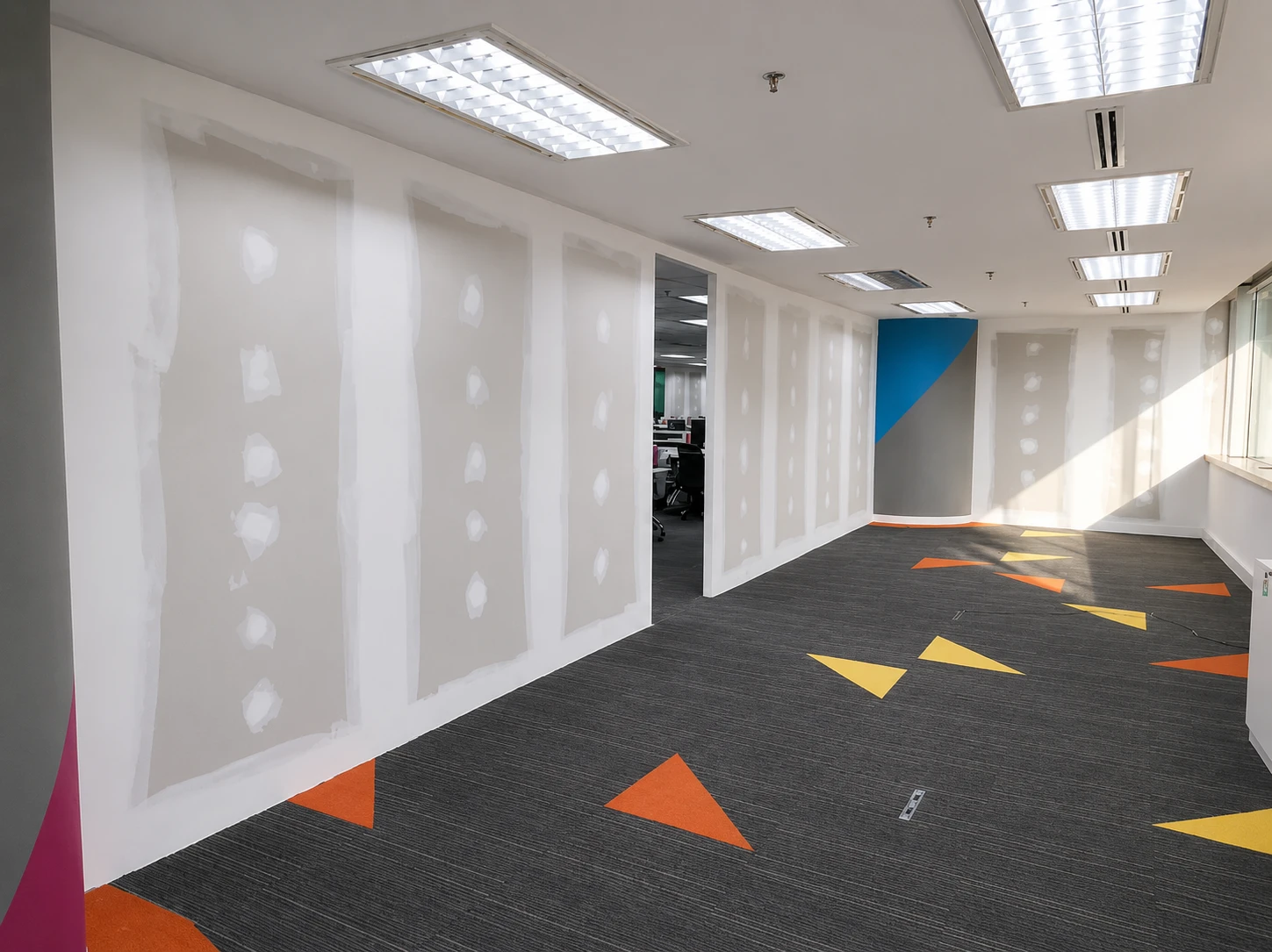
Our guide to ceiling partitions versus full-height walls explains the trade-off in more detail. If you are mixing glass and solid walls, our sibling article asks whether you should mix glass office partitions with drywall.
4Can You Upgrade the Ceiling Without Replacing the Grid?
Quick Answer: Yes, if the grid is sound and on a standard module. You can drop in acoustic tiles to cut open-plan noise, fit new LED panels in place of old troffers, and repaint or re-trim the visible edges. The office looks new while the frame above stays put.
Tiles do most of the visual and acoustic work in a grid ceiling. Changing them is often the best value upgrade on an inherited grid.
- Acoustic tiles soak up speech noise in open-plan areas. Our guide on how an acoustic ceiling reduces office noise explains what to look for.
- Uniform new tiles remove the patchwork of mismatched replacements that builds up over years of tenants.
- LED panels sized to the module replace older troffers without new cut-outs. The fittings and wiring are coordinated with your electrical contractor, not supplied by the ceiling team.
- Metal tiles give a sharper, more modern look in reception or pantry zones, as long as the grid can carry them.
Check one thing before ordering: tile edge and thickness must suit the existing tees. A tile that is the right size but the wrong edge profile will sit badly and rattle.
5Project Spotlight: Office Partitions Under a Ceiling Grid
Quick Answer: Recent Hypro jobs show both sides of the decision. In one office, new drywall rooms with rockwool insulation sit under a suspended grid with troffer lights. In Uptown Damansara, drywall and black-framed glass partitions are going in under the office ceiling. At Sunway Velocity mall, a full new suspended metal framework was built from scratch.
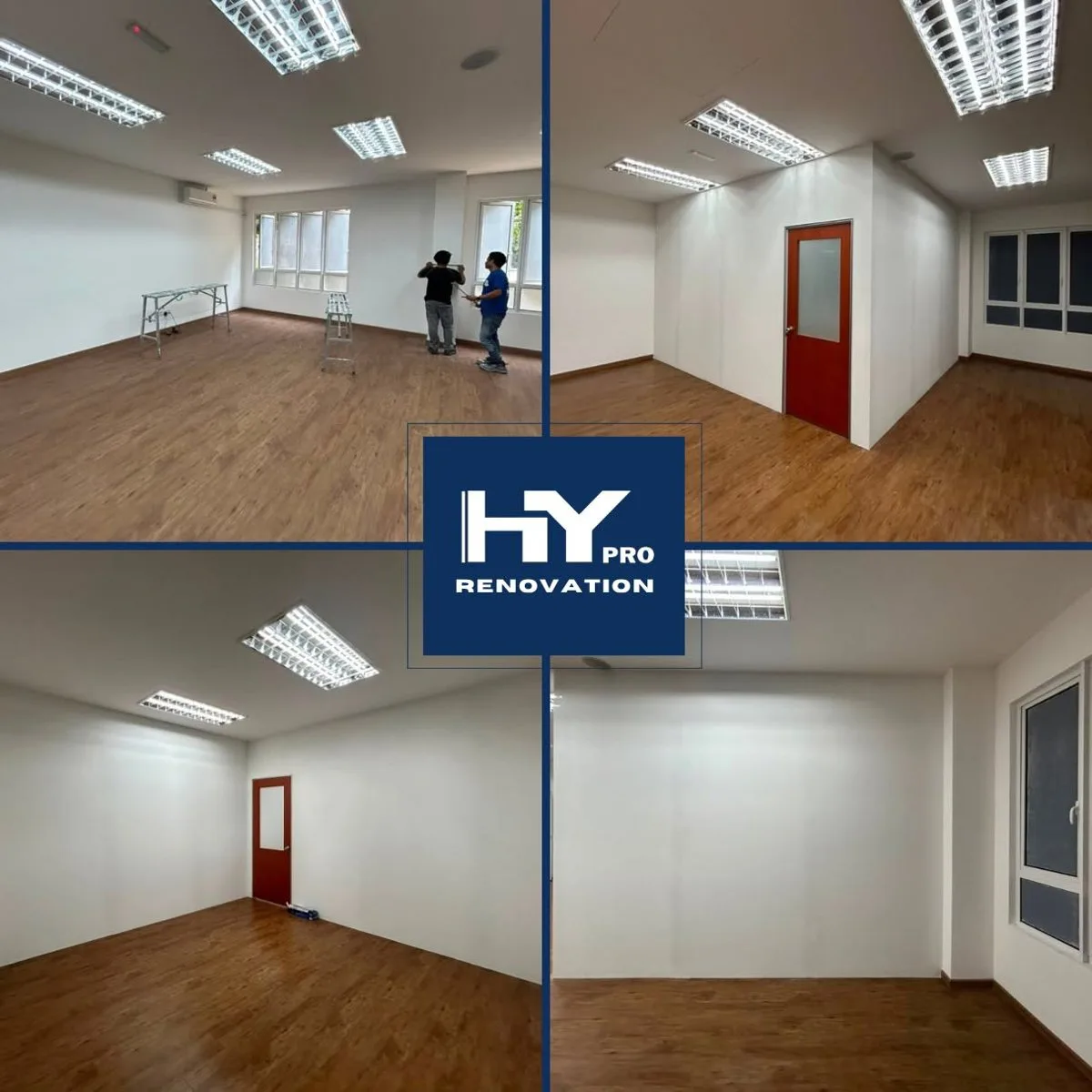
Office rooms with rockwool insulation. For an office client, Hypro built drywall partitions with rockwool insulation, doors and ceiling works. The finished rooms sit under a suspended grid with troffer lights, with the new walls meeting the ceiling cleanly. The rockwool here is for insulation between rooms, not a fire rating.
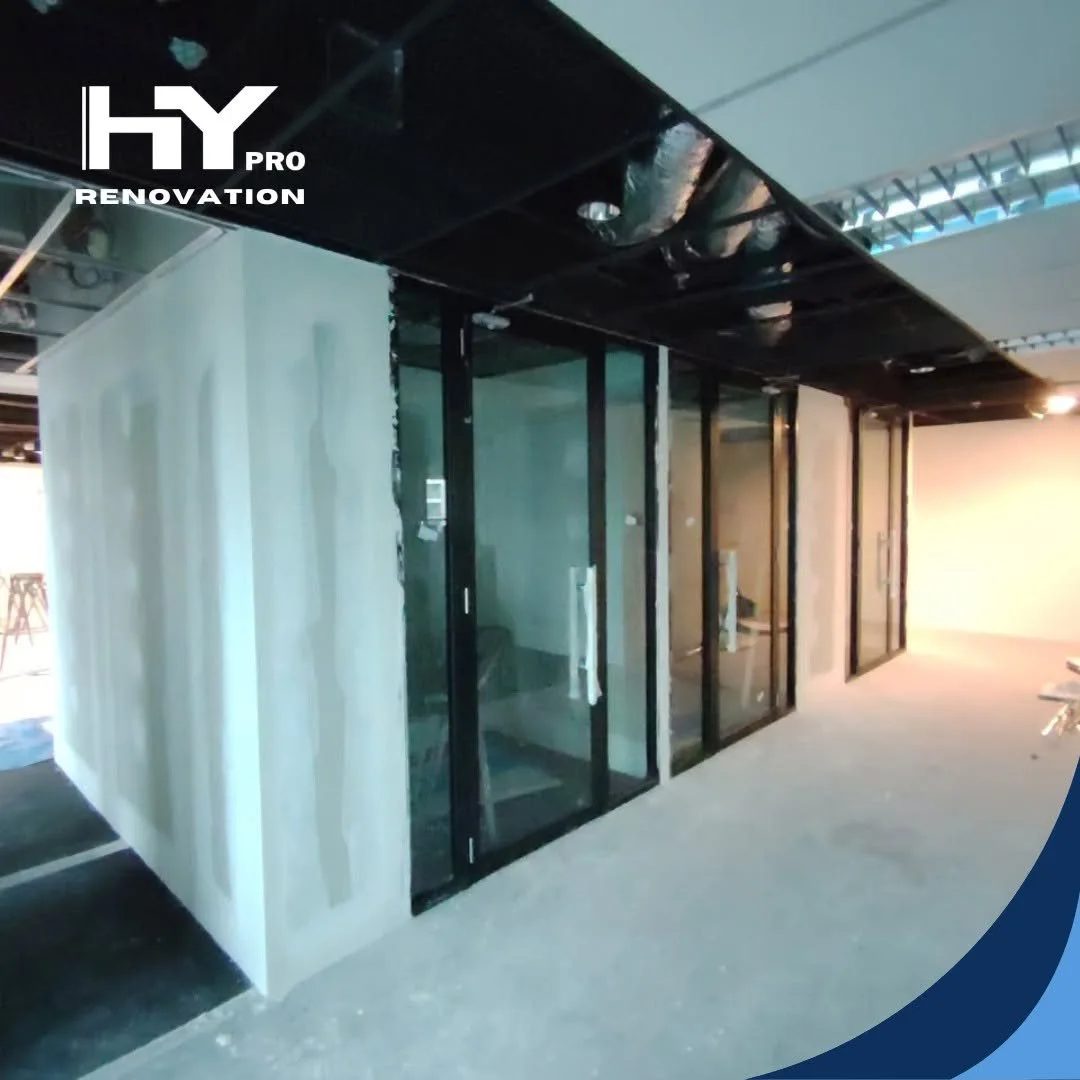
Uptown Damansara office. In this ongoing job, Hypro is combining gypsum drywall partitions with black aluminium-framed glass partitions and glass swing doors. The aim is defined workspaces that still feel open. The photo, taken mid-installation, shows the ceiling above still open in places while the partition heads are set.
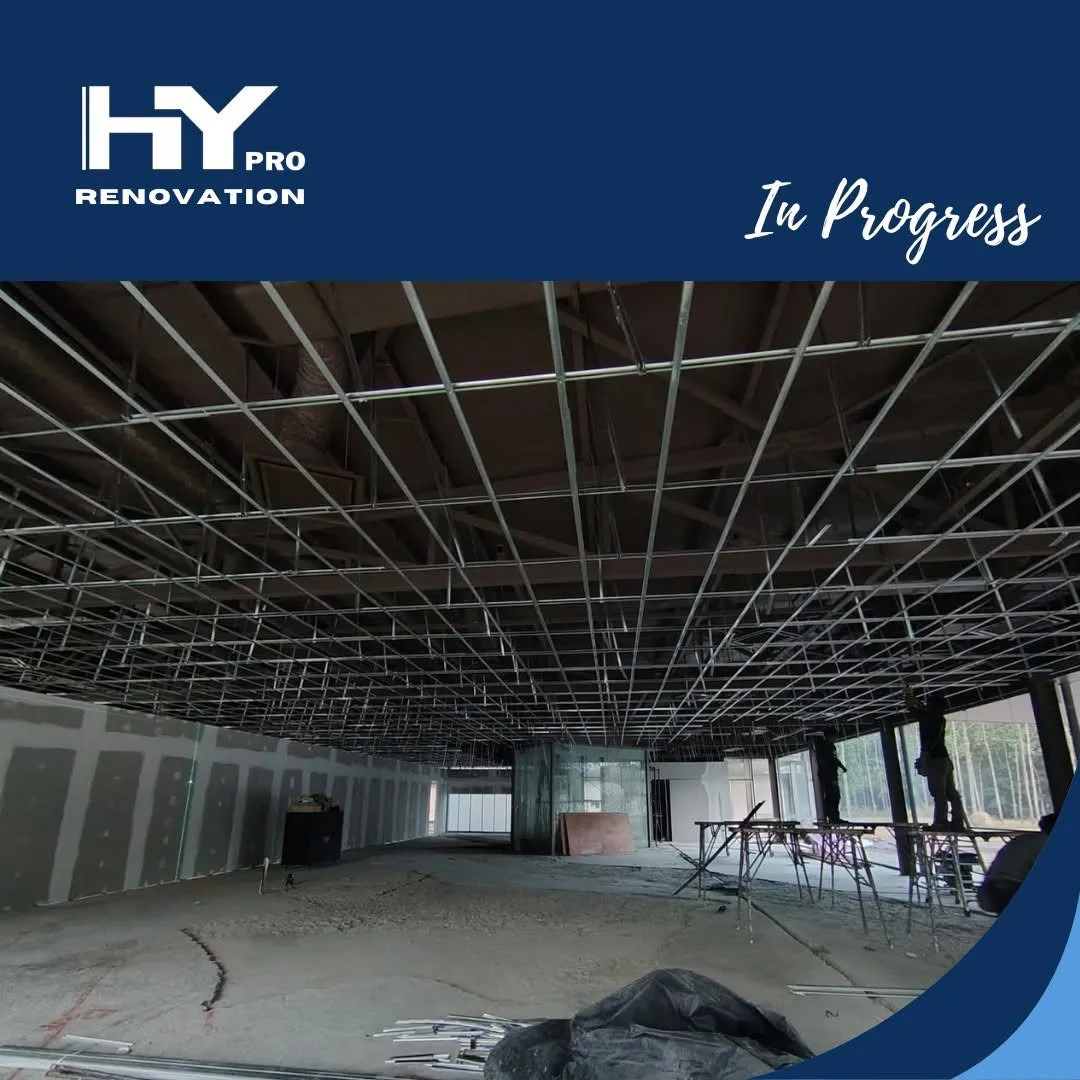
Sunway Velocity restaurant, the replace route. When a space needs a fresh start, the frame goes in first. At an F&B restaurant in Sunway Velocity mall, Hypro is building an extensive suspended metal ceiling framework before boarding with gypsum. The work follows the mall’s renovation guidelines, approved working hours and site access procedures, with ceiling, partition and M&E coordination agreed from the start.
Office clients such as MBSB, InterPacific and @WORK Pavilion Bukit Jalil also appear in our project portfolio.
6What Does Each Option Cost for a 2,500 sq ft Office?
Quick Answer: For an illustrative 2,500 sq ft office, a new grid with mineral fibre tiles runs about RM10,000–RM17,500 before removal of the old one. Reusing the grid with new tiles is an indicative RM5,000–RM10,000, and keeping the ceiling and swapping damaged tiles is often under RM2,000.
| Option | Ceiling cost | Removal of old ceiling |
|---|---|---|
| Keep, spot tile replacement | RM 500 – 2,000 (indicative estimate) | None |
| Reuse grid, new tiles throughout | RM 5,000 – 10,000 (indicative estimate) | Old tiles only |
| New grid, mineral fibre tiles | RM 10,000 – 17,500 | RM 2,500 – 5,000 (indicative estimate) |
| New grid, acoustic tiles | RM 15,000 – 25,000 | RM 2,500 – 5,000 (indicative estimate) |
Illustrative scenario. New-grid figures use the base rates on our service pages (mineral fibre RM4–7, acoustic tiles RM6–10 per sq ft). Keep, reuse and removal figures are indicative estimates. Excludes lighting, M&E, fire services and after-hours premiums.
The gap is large, which is why the condition check matters. If the grid passes, reusing it frees up budget for partitions, acoustic tiles in meeting rooms or a feature ceiling at reception. Our suspended ceiling service page lists the full rate card for new systems.
Want the three options priced for your floor?
Share your floor plan and a few photos of the ceiling. We will come back with keep, reuse and replace costs for your actual area. Get a side-by-side ceiling quote →
7How Should the Lease Shape Your Ceiling Decision?
Quick Answer: Read the reinstatement clause first. If you must return the landlord’s ceiling at handback, keeping and protecting the existing grid is usually cheapest. If the landlord lets the fit-out stay, a new ceiling can be worth it on a longer lease. Get any change approved by the building manager in writing.
The tenancy agreement often decides more than the ceiling’s condition. Work through these steps before you sign off the ceiling scope:
- Read the reinstatement clause. Check whether you must return the original grid and tiles, a bare slab, or nothing.
- Photograph the ceiling at handover. Record stains and damage so you are not charged for them later.
- Inspect the grid and tiles. Use the checklist above, then ask your contractor to confirm.
- Draw partitions and ceiling together. Mark which walls stop at the grid and which go to the slab.
- Get keep, reuse and replace prices. Compare them against the lease length and the reinstatement cost.
- Submit for building approval. Send the ceiling plan and method statement to the building manager, and confirm the fire contractor for any sprinkler or detector changes.
Our guide to planning office partitions for a new office lease covers the wall side of the same checklist. If the office has to keep trading during the works, our sibling article on planning ceiling installation without closing your business explains how to phase it.
8Conclusion
An inherited suspended ceiling is an asset until proven otherwise. Check the grid and the tiles separately, draw your partitions, and read the reinstatement clause before anyone quotes a full replacement.
If the grid is straight, clean and on a standard module, keep it and put the money into new tiles, better acoustics and the rooms your team needs. Replace it when it sags, rusts, fights your layout, or when a long lease lets the new ceiling stay behind.
Either way, plan the ceiling and the walls on one drawing, and the office will come together faster and cost less to hand back.
9Frequently Asked Questions
1. Should I replace the suspended ceiling when I move into a new office?
Not automatically. If the grid is level, rust-free and on a standard module, you can usually keep it and replace only damaged or tired tiles. Replace the grid when it sags, is corroded, clashes with your new partitions, or the lease lets the new ceiling stay.
2. Can I keep the grid and just change the ceiling tiles?
Yes. The grid is the long-lasting part of the system, and tiles can be swapped for new mineral fibre, acoustic or metal tiles as long as their size and edge profile suit the existing tees.
3. How much does a new ceiling grid cost per square foot?
Our base rates are about RM4 to RM7 per square foot installed with mineral fibre tiles, RM6 to RM10 with acoustic tiles and RM9 to RM15 with metal tiles. Removal of the old ceiling, lighting and M&E are priced separately.
4. How do I know if an existing ceiling grid is in good condition?
Look for straight, level runners, no rust, firmly locked tees and taut hanger wires. Lift a few tiles near air-con units and windows. Sagging, corrosion, bent tees and many past patches are signs the grid should be replaced.
5. Can new office partitions be built under an existing ceiling grid?
Yes. Partitions that stop at the ceiling line are built under the grid, which is cut and trimmed along each wall. Rooms that need speech privacy often need walls to the slab, which means opening the ceiling along those lines.
6. Do I have to reinstate the landlord’s ceiling grid when my lease ends?
It depends on the reinstatement clause in your tenancy agreement. Some landlords want the original grid and tiles back, some want a bare slab, and some let the fit-out stay. Check the clause before deciding to remove the existing ceiling.
Not sure whether to keep or replace your office ceiling?
Hypro’s CIDB-certified crew has over 20 years of experience installing and upgrading suspended, acoustic and plaster ceilings for offices across KL and Selangor. We price keep, reuse and replace side by side and plan the ceiling with your partitions.