Last updated: 7 November 2026
Gypsum board is the default ceiling for many shops in KL and Selangor malls, and for good reason. Shoppers look up more than you think. The ceiling frames the product, hides the services, and carries the lighting that makes jewellery sparkle.
A mall store is not a shoplot, though. The landlord sets the rules, the opening date is fixed, and work often happens at night. The void above is shared with sprinklers, air-con and the mall’s own services. Those pressures decide whether gypsum is the right call and how it should be built.
At Hypro Renovation we build ceilings, partitions and shopfronts for commercial clients across the Klang Valley, including mall retail units. This guide covers where gypsum works in a store, what it costs, how the mall process shapes the job, and a layered curved ceiling we built for a jewellery store in a KL mall.
The short video below shows how a curved plasterboard ceiling is framed on site, which is the same principle behind the layered retail ceilings in this guide.
Watch: how a curved plasterboard ceiling is framed and boarded
A profile manufacturer shows a curved plasterboard ceiling built step by step, from bending the hand-shaped track to fixing the boards. The same idea, a frame cut to the curve before any board goes up, is how layered retail ceilings are made.
Source: I Profili srl on YouTube
1What Is a Gypsum Ceiling and Why Do Mall Stores Use It?
Quick Answer: A gypsum ceiling is gypsum board screwed to a hidden metal frame, then jointed, skimmed and painted into one smooth surface. Mall stores use it because it can be shaped into bulkheads, coves and curves, and because it gives lighting a clean surface to work with. In Malaysia it is usually what people mean by a plaster ceiling.
Retail designers like gypsum because it does what the brand asks. It can step down over a counter, curve around a display wall, or hide a strip of LED light in a cove. A lift-out tile grid cannot do any of that.
The trade name causes confusion. Most “plaster ceilings” in Malaysian shops today are gypsum board, not wet plaster. Our comparison of gypsum and plaster ceilings explains the difference if your designer specifies one by name.
| Ceiling option | RM / sq ft installed | Best use in a mall store |
|---|---|---|
| Flat gypsum | RM 5 – 7 | Sales floor with track or downlights |
| Gypsum L-box with cove lighting | RM 8 – 12 | Perimeter glow, over counters and wall displays |
| Curved or layered gypsum design | RM 12 – 18 | Signature feature, entrance or centre of store |
| Suspended grid, mineral fibre tiles | RM 4 – 7 | Stockroom, staff area, back of house |
| Suspended grid, metal tiles | RM 9 – 15 | Modern industrial look with full access |
Source: Hypro Renovation project quotations, KL and Selangor, 2024–2026, as listed on our service pages. Final rates depend on ceiling height, quantity, design and mall access rules.
2Which Retail Stores Suit Gypsum Best?
Quick Answer: Stores that sell on looks get the most from gypsum: jewellery, beauty, fashion and premium lifestyle brands. Stores that change layout often or carry dense services, such as electronics or pharmacies, often do better with a flat gypsum front and a grid at the back. Almost every store benefits from a grid over the stockroom.
The question is not “gypsum or not”. It is how much of the store should be gypsum, and how shaped it should be. This is how we usually split it by store type.
| Store type | Usual ceiling mix | Why |
|---|---|---|
| Jewellery and watches | Layered or curved gypsum with cove and spot lighting | Lighting sells the product; the ceiling is part of the display |
| Fashion and footwear | Flat gypsum with track lighting, feature at entrance | Track lights move as collections change |
| Beauty and cosmetics | Flat gypsum with L-box over counters | Even, flattering light at testing counters |
| Electronics and telco | Flat gypsum front, suspended grid behind | Frequent layout and cabling changes |
| Pharmacy and convenience | Mostly flat gypsum or grid | Bright, practical and easy to maintain |
| Stockroom in any store | Suspended grid | Valves and cable trays stay reachable |
Hypro Renovation guidance from commercial fit-outs in the Klang Valley, 2026. Indicative only; your mall’s design criteria and your brand manual come first.
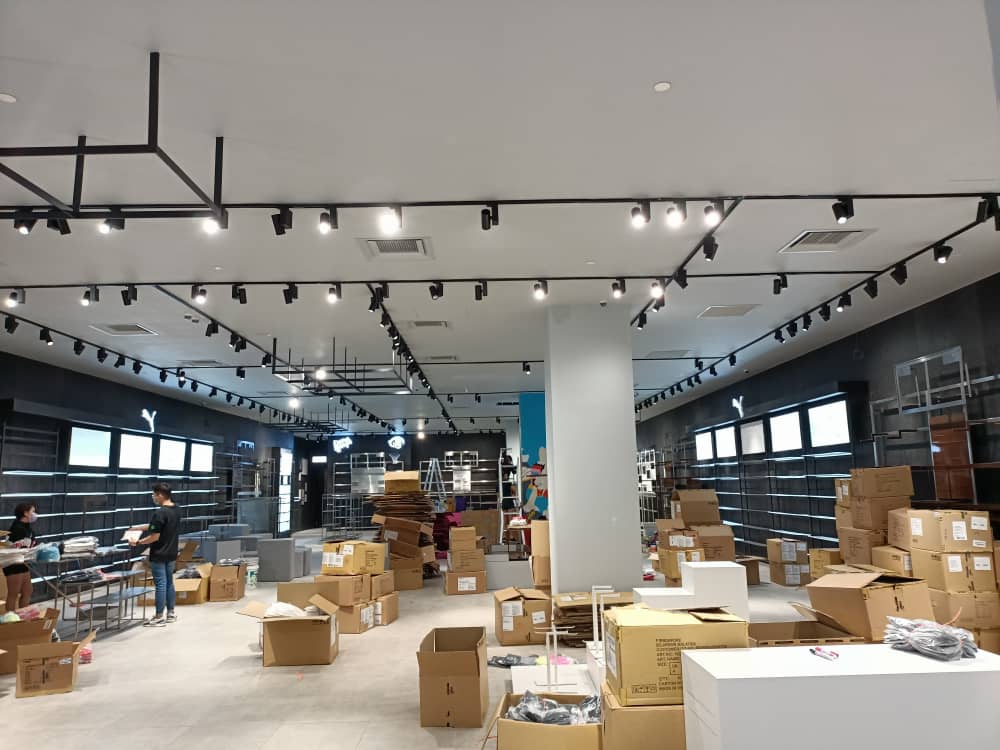
Opening a store in a KL or Selangor mall?
Send us your designer’s ceiling plan and the mall’s fit-out guide. We will price each zone and flag anything the mall is likely to query. Ask for a retail ceiling quote →
3How Does Gypsum Work With Store Lighting and Services?
Quick Answer: Every light, diffuser, sprinkler and detector position must be fixed on the ceiling plan before boarding, because cutting finished gypsum later leaves patches. Cove troughs and light lines are built into the frame. The lighting, air-con and fire services are installed by their own contractors; the ceiling team builds around them.
In a store, the ceiling and the lighting are designed as one piece. A cove only glows evenly if the trough depth and lip are right. That is ceiling work. The fittings, wiring and controls are coordinated with your electrical contractor, not supplied by the ceiling team.
What to settle before the first board goes up:
- Light layout for downlights, track runs, cove troughs and linear light lines.
- Air-con openings for cassette units, diffusers and return grilles.
- Fire services at the final ceiling level. Sprinklers and smoke detectors are set by the mall’s approved fire contractor.
- Access panels under every valve, damper and junction box, placed where they will not spoil the design.
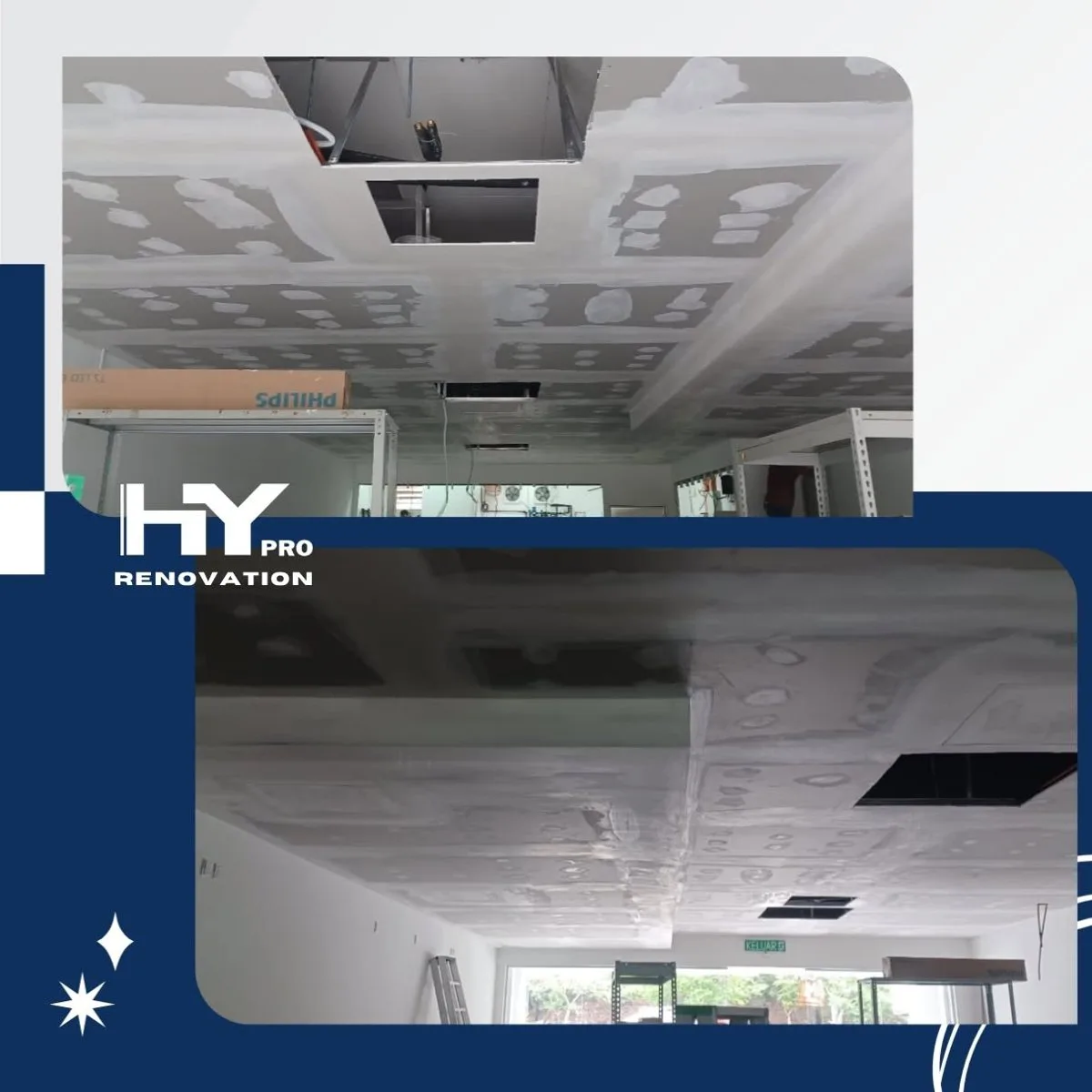
The photo above, from a retail shoplot in Sri Petaling, shows the stage where this planning pays off. The openings for air-con and access are already cut and framed, so nothing needs to be hacked out after skimming. For lighting ideas that suit gypsum, see our guide to ceiling LED strip and cove lighting.
4What Will the Mall Ask For Before Ceiling Work Starts?
Quick Answer: Most KL and Selangor malls ask for approved drawings, a method statement, contractor registration and insurance, and they limit noisy work to approved hours. Material delivery goes through the loading bay at set times. Build these rules into the programme from day one, or the ceiling becomes the reason the store opens late.
Every mall has its own fit-out guide, but the pattern is similar. Work through these steps before the ceiling contractor mobilises:
- Get the mall’s fit-out guidelines. Note ceiling height limits, approved materials and any design criteria for the shopfront zone.
- Submit the ceiling plan and method statement. Include the reflected ceiling plan, sections through bulkheads and the access panel layout.
- Register the crew and insurance. Malls usually want worker passes and a valid policy before anyone enters the unit.
- Agree working hours and deliveries. Cutting and drilling are often night work, and boards come in through the loading bay at set slots.
- Coordinate fire services. Confirm when the mall’s fire contractor will isolate detectors and reset sprinklers to the new ceiling level.
- Book the ceiling inspection. Close up only after the mall and your M&E contractors have signed off the services above.
Our article on what malls require for a drywall partition fit-out covers the same approval process from the wall side, which runs in parallel with the ceiling.
5Project Spotlight: A Layered Curved Gypsum Ceiling in a KL Mall Store
Quick Answer: For a jewellery store in a Kuala Lumpur shopping mall, Hypro built a layered curved design in gypsum board with integrated lighting. Stepped curved bands frame a central lit panel, so the ceiling becomes part of the store’s display.
This project shows what gypsum can do that no tile system can. The design uses rings of curved gypsum bands that step up towards a large central light panel. Each layer is a separate curved bulkhead, framed and boarded to follow the line of the one below it.
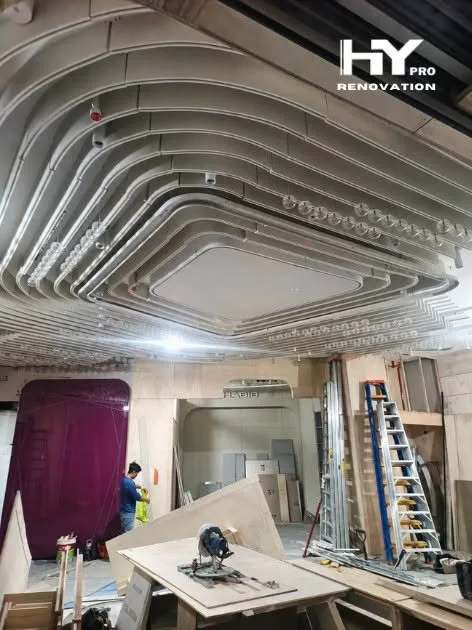
In the in-progress photo, the light positions along the bands and the central panel opening are already formed. Changing them now would mean re-cutting curved board.
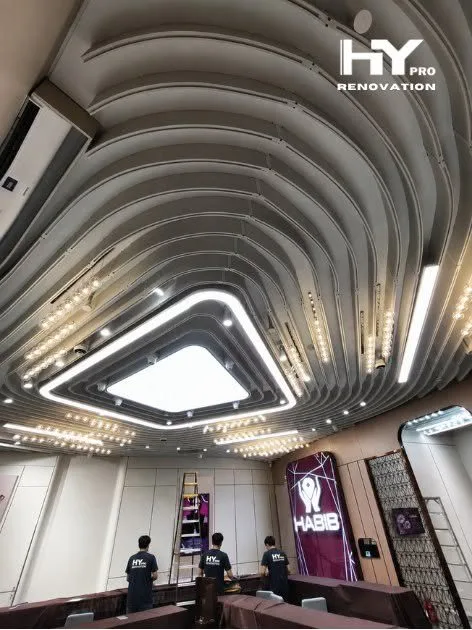
Once lit, the layered curves carry the light around the room. The central panel gives soft, even light over the sales floor, while the curved bands carry rows of small lights that add sparkle around the room.
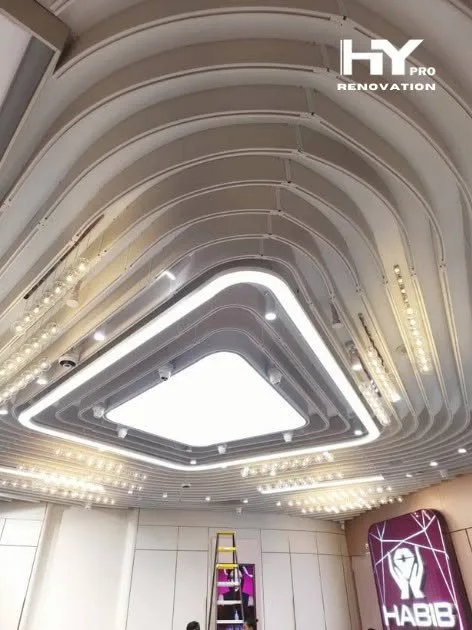
Two other projects show the same approach on different budgets. In a retail shoplot in Sri Petaling, Hypro handled the ceiling and partition works in gypsum board, with service openings planned in. At an F&B restaurant in Sunway Velocity mall, an ongoing job, the plaster ceiling sits on an extensive suspended metal framework with gypsum board. That job runs under the mall’s renovation guidelines, approved working hours and site access procedures, with ceiling, partition and M&E coordination agreed from the start.
Retail names such as COS KLCC, Parkson and Lohas Pottery at Pavilion Bukit Jalil also appear in our project portfolio.
6What Does a Shaped Ceiling Cost for a 1,000 sq ft Mall Store?
Quick Answer: Using our base rates, an illustrative 1,000 sq ft store runs about RM5,000–RM7,000 for flat gypsum throughout, RM5,900–RM8,500 with an L-box perimeter, and RM7,800–RM11,400 with a curved feature zone. Mall night work, M&E and fire services are extra.
| Design level | Area split | Ceiling cost |
|---|---|---|
| Simple | 1,000 sq ft flat gypsum | RM 5,000 – 7,000 |
| Lit perimeter | 700 sq ft flat, 300 sq ft L-box with cove | RM 5,900 – 8,500 |
| Feature store | 600 sq ft flat, 400 sq ft curved or layered | RM 7,800 – 11,400 |
Illustrative scenario using the base rates on our service pages (flat RM5–7, L-box RM8–12, curve RM12–18 per sq ft). Excludes lighting, M&E, fire services, removal of an existing ceiling and after-hours premiums.
Mall work adds costs that a shoplot does not. Night shifts, loading bay slots and extra protection for the common area all add time. As an indicative estimate, after-hours and mall access requirements can add around 10–20% to the ceiling labour cost, depending on the mall and the hours allowed.
For a deeper look at design choices and pricing, read our gypsum ceiling cost and design guide, or see the full rate card on our plaster ceiling service page.
Want a feature ceiling without blowing the fit-out budget?
We can price a flat, lit-perimeter and feature option side by side so you can choose with real numbers. Get three ceiling options priced →
7When Is Gypsum the Wrong Choice in a Store?
Quick Answer: Skip gypsum where the void is packed with services that need regular access, where the mall requires a specific ceiling system, or where the lease is short and reinstatement is strict. In those zones a suspended grid is cheaper to live with and quicker to strip out.
Gypsum is a finish, and finishes are harder to open. These situations push the other way:
- Stockrooms and staff areas where air-con valves, cable trays and the mall’s own services sit overhead. A suspended ceiling keeps them reachable.
- Short leases where the tenancy requires a bare slab or the mall’s standard ceiling at handback. Gypsum takes longer to strip.
- Stores that change layout every season without track lighting. Each new light position means a cut and a patch.
The ceiling also has to meet the shopfront. Bulkhead height, signage depth and the glass line all meet at the entrance, so plan them together. Our sibling guide on choosing shop front glass for a cafe or F&B outlet covers that junction for food outlets, and how a plaster ceiling in Malaysia differs for business covers the wider commercial picture.
8Conclusion
For most mall retail stores, a gypsum ceiling is the right choice for the sales floor. It takes the shapes a brand needs, gives the lighting a clean surface, and looks finished in a way a tile grid cannot.
The way to make it work is to be selective. Put the shaped work where customers look, keep the stockroom on a grid, and fix every light, diffuser and access panel on the plan before boarding. Then build the programme around the mall’s approvals and working hours, not the other way round.
9Frequently Asked Questions
1. Is a gypsum ceiling suitable for a shop in a shopping mall?
Yes. Gypsum is the most common ceiling for mall sales floors because it can be shaped into bulkheads, coves and curves and gives lighting a smooth surface. Most stores pair it with a suspended grid in the stockroom so services stay easy to reach.
2. What does gypsum cost per square foot for a shop in KL?
Our base rates are about RM5 to RM7 per square foot for flat gypsum, RM8 to RM12 for an L-box with cove lighting, and RM12 to RM18 for curved or layered designs. Mall after-hours work, lighting and M&E are priced separately.
3. Is gypsum the same as a plaster ceiling?
In Malaysia, mostly yes. What people call a plaster ceiling today is usually gypsum board on a metal frame, jointed and skimmed to a smooth finish. Traditional wet plaster is rarely used for new commercial ceilings.
4. Can gypsum be curved or layered?
Yes. The frame is cut and bent to the curve first, then gypsum board is fixed and finished. Layered designs stack several curved bulkheads, often with cove or spot lighting built in, as in the jewellery store project shown in this guide.
5. Do malls allow ceiling work during opening hours?
Usually only quiet work. Most malls limit cutting, drilling and deliveries to approved hours, often at night, and route materials through the loading bay. Check the mall’s fit-out guidelines before setting your programme.
6. Where should a retail store use a suspended ceiling instead?
In stockrooms, staff areas and anywhere air-con valves, cable trays or mall services need regular access. A suspended grid lets staff lift a tile instead of cutting finished gypsum, and it is quicker to strip when the lease ends.
Planning the ceiling for your mall store?
Hypro’s CIDB-certified crew has over 20 years of experience building gypsum, plaster, suspended and feature ceilings for retail and F&B outlets in KL and Selangor malls. We work to mall fit-out rules and coordinate with your lighting, M&E and fire contractors.